2 years in trading
Mikhail is 23, and he now trades mostly crypto, occasionally stepping into traditional financial markets (TradFi).
He doesn’t single out any particular coins: over 2 years there have been too many trades. He calls trading “the hardest way to make easy money” and admits he is genuinely passionate about the market: he follows the crypto industry, streams from time to time, and talks with other traders.
Mikhail describes his workday without any embellishment.
- He trades on his father’s laptop, without multiple monitors or expensive equipment.
- He wakes up around noon, checks Fed news, Bitcoin dominance, and political events, has breakfast, and only then starts analyzing charts.
- On weekdays, he spends 6–8 hours trading.
But it wasn’t always like this…
From college and web design to futures
Mikhail got into crypto at 17–18: he traded on major exchanges and was interested in NFTs and various projects.
Back then, he was cautious about futures and leverage.
After dropping out of college, he spent about a year and a half doing web design, but burned out.
He then took a 120,000-ruble crypto course covering spot trading, airdrops, and DeFi, after which he got a job at a Wildberries warehouse.
It was a colleague from the warehouse who got Mikhail into futures trading.
In January 2025, the two of them started opening short positions on new listings on one of the crypto exchanges.
According to Mikhail, about 70% of those trades were profitable. They traded right during breaks at work, whenever there were no new orders and they had some free time.
A 150,000-ruble credit card
Over time, Mikhail quit the warehouse because he didn’t want to depend on a regular job.
He calls the period that followed a “dark” one: he took out a credit card with a 150,000-ruble limit and started actively trading the coins that were rising the most on the 5-minute chart.
He risked 10% of his deposit per trade and held up to 12 positions at once without stop-losses.
Mikhail links this behavior to his emotional state at the time.
Because of difficult life circumstances, he was under heavy stress, and trading became one of his few sources of excitement.
“It’s not the money itself that gives me a kick so much as the confirmation that I was right. That makes it twice as satisfying.”
In a month of trading like this, Mikhail grew his deposit from $1,000 to $2,500, and his best trade brought in $750 in 6 hours.
However, this approach came with a high risk of losing his capital.
The joy of his best trade to date was overshadowed by a freeze of his funds on the exchange.
Frozen funds and a month and a half of fighting
On the same morning Mikhail closed his most profitable trade to date, the exchange blocked his account and froze all his funds.
According to him, the reason was an AML check. All of his money was on the exchange at the time, so things got tough: he had to sell in-game skins worth 50,000 rubles at a discount and live on 60,000 rubles the following month.
For a month and a half, Mikhail contacted support every day and talked to other users who had run into the same problem. In the end, he managed to get every last cent back.
“As cliché as it sounds, it’s persistence. It really stung, because I’d been putting in the effort, working hard, and it was paying off.”
After that, Mikhail decided never to trade on that exchange again.
For him, the freeze was even harder to take than a stop-loss hit or a liquidation caused by his own mistake.
After all, this time he lost access to his money for reasons beyond his control.
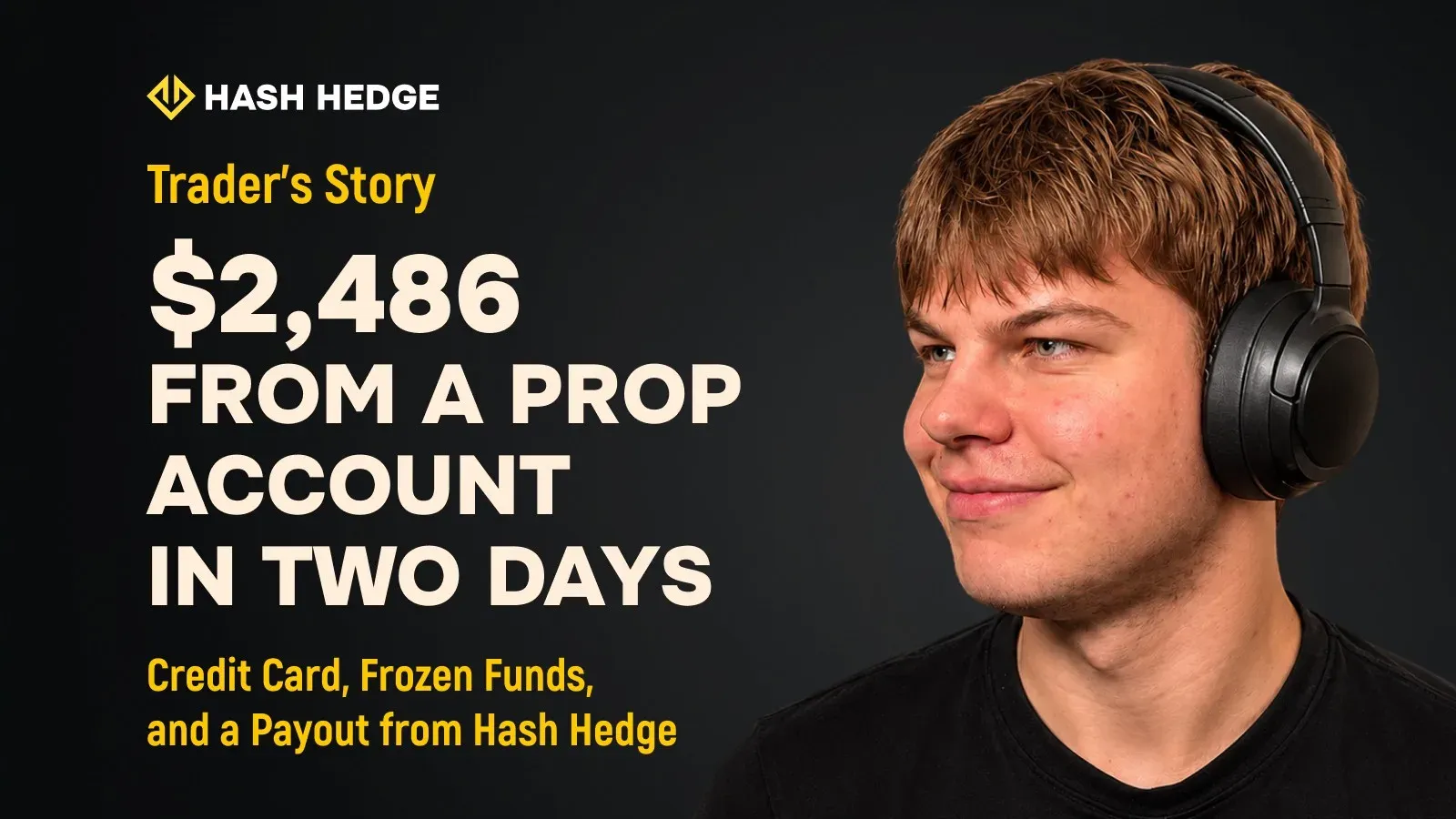
Hash Hedge: a way out and a $2,486 payout
In August and September 2026, Mikhail was living with his parents and working food delivery shifts for Yandex Delivery together with a friend.
His attempts to make money in the market weren’t paying off: his aggressive strategy didn’t work well with a small deposit, and he no longer wanted to trade small amounts.
So Mikhail decided to take prop trading seriously, seeing it as the only way out of his difficult financial situation.
He had received his first $10,000 account for free back in July through the Hash Hedge partner program, but lost it before completing Stage 1. Mikhail was getting used to trading with 5x leverage and trying to adapt his strategy to the new conditions.
Next came more attempts and the Hash Hedge trading contest, where he climbed to 13th place trading from two accounts, but eventually lost both.
Over a few months, Mikhail got 5 Hash Hedge challenges:
- July 13, 2026 – $10,000: lost the account.
- August 11, 2026 – $100,000: still active.
- September 11, 2026 – $10,000: lost the account.
- September 15, 2026 – $10,000: received a $2,486 payout, later lost the account.
- October 20, 2026 – $10,000: lost the account.
Key result: a $2,486 payout from a $10,000 account

Getting his first payout was an especially emotional moment for Mikhail.
Shortly before that, he was in the car with his father, telling him he would soon receive money from a prop firm. His father didn’t believe him and thought it was a scam. At the time, Mikhail had only 2,000 rubles left on his card.
But the payout arrived in just two days, even faster than he had expected. Mikhail simply showed his father the balance.
“I told my dad: it’s a skill. If I lose it, I’ll make it back.”
Mikhail compares losing an account to a broken heart: over time, it gets easier to deal with. But the main thing that has changed during his time trading on Hash Hedge is his attitude to risk.
During the trading contest, he got carried away: he made $600 on each of his two accounts in just a couple of hours, but wanted to collect the prize money the same day and ended up losing both accounts.
Now Mikhail tries to control his emotions, stick to risk management, and choose trades with a risk-to-reward ratio of 1:4–1:5.
Trading approach: volume, liquidity, and market makers
Mikhail trades intraday: he usually holds positions for 2 to 12 hours and tries to close them before going to bed.
He keeps no more than 2–3 trades open at a time and uses analytics services and TradingView to analyze the market.
Mikhail considers classic technical analysis ineffective on young altcoins.
New coins have almost no price history, and in his view their moves are largely driven by market makers: accumulating positions, a sharp rally, liquidating longs and shorts, and then a gradual price decline.
He hardly uses the RSI and MACD indicators, since he believes they only reflect price moves that have already happened.
Instead, Mikhail analyzes trading volume, capital inflows, open interest, and liquidations.
Without sufficient volume, he doesn’t enter a trade. His screener scans the market every 20–30 seconds, analyzes a 20-minute window, and sends a signal only when volume is $200,000 or more. This is how Mikhail filters out low-liquidity coins.
Mikhail prefers to act on the first or second signal, the third at most: by the seventh, the main price move may already be over.
His entire trading setup fits on one screen: trend, volume, liquidations, support and resistance levels, open interest, delta, and funding rate. His main timeframes are 15 minutes and 1 hour.
These days, Mikhail opens long positions more often, but he doesn’t tie himself to one market direction. One of his main scenarios is trading the local rally after a coin gets listed.
Mikhail advises Hash Hedge traders to keep a separate eye on open interest and liquidations on major exchanges, where most of the crypto market’s liquidity is concentrated.
Stop-losses and a 1:5 risk-to-reward ratio
The biggest change in Mikhail’s trading came in fall 2026, after he lost several accounts in a row. Before that, he opened $1,000 positions with 5x leverage on a $10,000 Hash Hedge account and often traded without stop-losses.
He explained his logic by how market makers behave: price often makes a false breakout, takes out the stops, and only then moves in the expected direction.
That’s why Mikhail preferred not to cap his losses in advance, counting on growing his deposit faster.
This aggressive trading sometimes delivered fast results. For example, on the challenge he got his payout from, he hit the 8% profit target in just one day with 2–3 trades. But along with high returns came the risk of losing the account just as quickly.
Today, Mikhail uses stop-losses and aims for a 1:5 risk-to-reward ratio.
In his words, this approach keeps him out of the red even after several losing trades in a row, as long as the winning trades cover the losses.
“If I go in with $500 and close even at 1 to 3, that’s plus $1,500. Then I can be wrong three more times, lose $500 each time, and still break even.”
As an example, Mikhail recalls his most profitable trade ever. He set his stop-loss and take-profit in advance at 1:5, opened a $500 position with 20x leverage on an exchange, and headed off to a doctor’s appointment.
Two hours later, the trade closed with a profit of about $2,500.
Even this trade didn’t come without mistakes: right before it, Mikhail tried to profit from the funding rate and got stopped out. That’s why he warns that relying on funding alone is risky, especially for beginners.
Discipline: how prop trading taught him to manage risk
Mikhail admits that over his time in trading, he has blown his deposit more than a hundred times. Gradually, he learned to take losses more calmly and to accept uncertainty: any trade can turn out to be either a winner or a loser.
In his words, it was prop trading that helped him take discipline and risk management more seriously.
On his $10,000 challenge, the daily loss limit was $500. There were days when Mikhail was down $300–400 and just one step away from losing the account. Breaching the limit means losing the account, so the consequences of breaking risk management rules become especially tangible.
On a regular exchange, Mikhail could keep trading even after a losing streak. In prop trading, the limits made him watch his risk more closely and stop in time.
“Prop trading gave me a sense of self-preservation. I’d come back another day and win it back: minus $400 one day, plus $500 the next.”
His attitude to stop-losses has changed too. He used to avoid them on purpose, but today his answer to “trade with a stop or without?” is clear: only with a stop.
For those who currently have a regular job and are thinking about switching to trading, Mikhail recommends trying a small prop account first, such as $10,000. At the same time, he stresses that far from everyone passes a challenge on their first try.
For Mikhail himself, this experience has changed not only his trading strategy, but also his attitude to risk, money, and his own decisions.
Key takeaways
-
Stop-losses matter more than confidence in your strategy. Trading without stops let Mikhail grow his deposit quickly, but just as quickly led to losing accounts. Switching to stop-losses and a 1:5 risk-to-reward ratio became the main change in his approach.
-
Volume and liquidity help assess price movement. When trading volatile altcoins, Mikhail relies on volume, open interest, and liquidations. He finds the classic RSI and MACD indicators less useful for his strategy.
-
A daily loss limit builds discipline. The prop firm’s limits taught Mikhail to control his losses, stop trading in time, and not try to win back losses after bad trades.
-
Persistence only pays off together with emotional control. Persistence helped Mikhail recover his frozen funds from the exchange, but in trading it sometimes turned into gambling and unjustified risk. Today, he considers discipline and managing emotions half the battle in trading.