What Is Elliott Wave Analysis?
Understanding market psychology is the cornerstone of successful crypto trading. One powerful tool many traders rely on is Elliott Wave patterns. It’s a method that helps predict price movements by identifying recurring wave patterns. In this guide, let’s break down Elliott Waves in the context of Web3 markets.
Long Story Short
Elliott Wave Theory, developed by Ralph Nelson Elliott in the 1930s, is a technical analysis approach based on the idea that markets move in repetitive cycles caused by collective investor psychology. These cycles manifest as waves, so-named patterns of price action that repeat over time and across different scales.
In crypto trading, recognizing these waves helps you anticipate bullish runs, corrections, and market reversals, giving you a strategic edge in the volatile market.
The Basics: Impulse Waves and Corrective Waves
Elliott Wave patterns consist mainly of two wave types:
- Impulse Waves. A sequence of five waves moving in the direction of the main trend.
- Corrective Waves. A three-wave sequence moving against the main trend, representing pullbacks or consolidation phases.
These waves form fractal structures and are smaller waves nested within larger ones. It makes Elliott Wave Theory versatile for different timeframes, from minutes to months.
Why Elliott Wave Analysis Works Well in Crypto Trading
Crypto markets are notoriously volatile, trading 24/7 with sudden price swings. Elliott Wave Analysis helps traders:
- Identify when a major trend starts or ends.
- Time entries and exits more precisely based on wave counts.
- Combine wave analysis with other indicators like RSI or volume for stronger signals.
For example, spotting Wave 3 (typically the strongest impulse wave) can help capture significant profit during a bull run cycle.
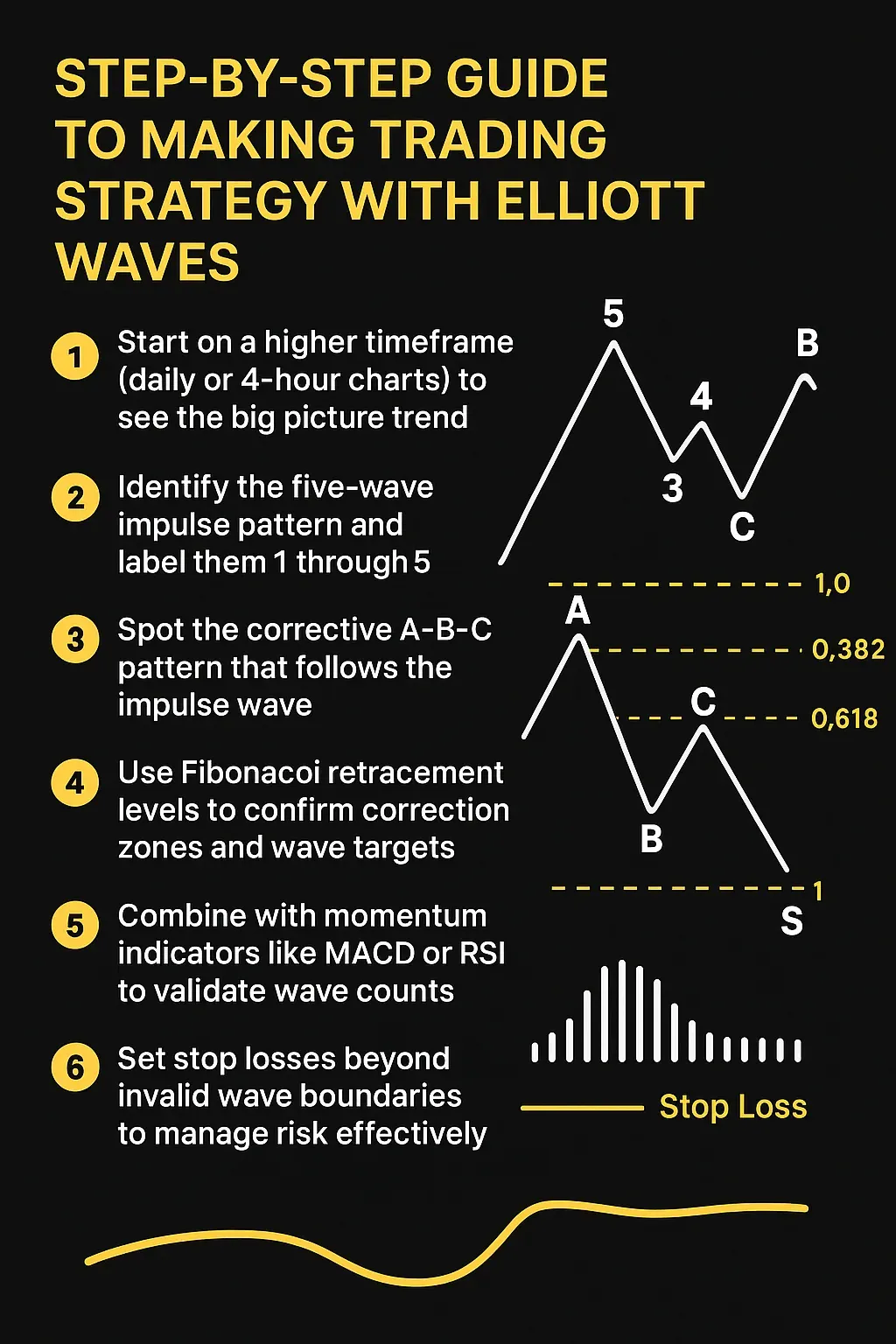
Step-by-Step Guide to Making Trading Strategy with Elliott Waves
- Start on a higher timeframe (daily or 4-hour charts) to see the big picture trend.
- Identify the five-wave impulse pattern and label them 1 through 5.
- Spot the corrective A-B-C pattern that follows the impulse wave.
- Use Fibonacci retracement levels to confirm correction zones and wave targets.
- Combine with momentum indicators like MACD or RSI to validate wave counts.
- Set stop losses beyond invalid wave boundaries to manage risk effectively.
Common Mistakes New Traders Make with Elliott Waves
Many beginners in crypto trading jump into Elliott Wave Analysis thinking it’s a quick way to predict exact price moves. The reality is that wave counting is part science, part luck. So, rushing into trades without proper confirmation can lead to losses. A common mistake is forcing the chart to fit your bias. For example, if you’re convinced Bitcoin is about to pump, you might label random price swings as “Wave 3” without following the core Elliott rules. This can create a false sense of confidence and push you into risky positions. So, review other indicators to make the right decision.
Another frequent error is ignoring multiple timeframes. Elliott Waves are fractal, meaning patterns repeat on different scales. If you only look at a 15-minute chart, you might miss the bigger trend playing out on the 4-hour or daily chart. Also, this can mean entering a trade just before a major reversal. Smart traders always zoom out to confirm their wave counts before committing capital.
Finally, many new traders rely solely on Elliott Waves without using additional indicators or volume data. While the theory can highlight potential turning points, combining it with tools like RSI, MACD, or Fibonacci retracement dramatically improves accuracy. Think of Elliott Waves as your map, but you still need a compass to navigate.
Most traders make the costly mistake of focusing only on strategy without considering account safety and risk protection.
Benefits and Limitations of Elliott Wave Analysis in Crypto
Benefits:
- Provides a structured framework to interpret complex market movements.
- Useful across all timeframes and assets.
- Helps anticipate major market reversals.
Limitations:
- Requires practice and experience to count waves.
- No method guarantees 100% accuracy.
- Crypto’s unpredictability can sometimes distort wave patterns.
How to Use Elliott Wave Analysis to Gain an Edge
- Spot the patterns first. Train your eye to identify the classic five-wave impulse and three-wave correction formations on your chart. Check multiple timeframes, from higher frames for the main trend to lower frames for precise entries.
- Know where you are in the cycle. Once you’ve mapped out the current wave count, start projecting the next likely move. If a five-wave sequence is wrapping up, expect a three-wave correction to follow. Positioning is all about understanding your place in the market’s rhythm.
- Understand wave behavior and rules. Certain structural rules can help set your invalidation points. For example, Wave 2 never retraces more than 100% of Wave 1, and Wave 4 should not overlap Wave 1’s price. These guidelines help you define entry zones, stop losses, and profit targets with more confidence.
- Leverage Fibonacci ratios for precision. Key levels like 0.382, 0.50, and 0.618 can highlight potential reversal areas within a wave. Wave 2 often retraces a Fibonacci portion of Wave 1, while Wave 3 frequently extends to at least 161.8% of Wave 1. These projections can sharpen your trade setups.
We Have Some Examples
- Five-Wave Impulse + Zigzag Correction (5-3 Pattern). The most classic setup — a strong five-wave move in the direction of the trend, followed by a sharp three-wave (A-B-C) zigzag correction. This combination signals a healthy trend continuation after a pullback.
- Five-Wave Impulse + Flat Correction. A five-wave advance followed by a sideways, choppy A-B-C correction where Waves A and B are similar in size, and C slightly breaks past A. Flats often appear before a strong move resumes, especially in Wave 4 positions.
- Double Zigzag. Two connected zigzag corrections, linked by a small countertrend move. This pattern signals a prolonged correction before the main trend restarts, often shaking out impatient traders.
Final Thoughts: Is Elliott Wave Analysis OK for Use?
For crypto traders looking to go beyond simple chart patterns, Elliott Wave Analysis offers a deeper insight into market psychology and price action. While it’s not a silver bullet, combining it with solid risk management and other technical tools can significantly improve your trading expertise.