The Market Changes Faster Than the Strategy
Any strategy is designed for a specific type of movement: trend, range, high or low volatility. As long as the market structure matches these conditions, results appear stable.
But crypto market phases change. A strong trend may be followed by a prolonged consolidation. Periods of high activity are replaced by declining volume. Volatility and strategy are closely connected: an approach built for momentum begins to generate false signals in sideways conditions.
This becomes especially noticeable during transitions between bull and bear markets. Strategies focused on buying pullbacks stop working during sustained declines. Trend-following systems, on the other hand, lose efficiency during periods of uncertainty.
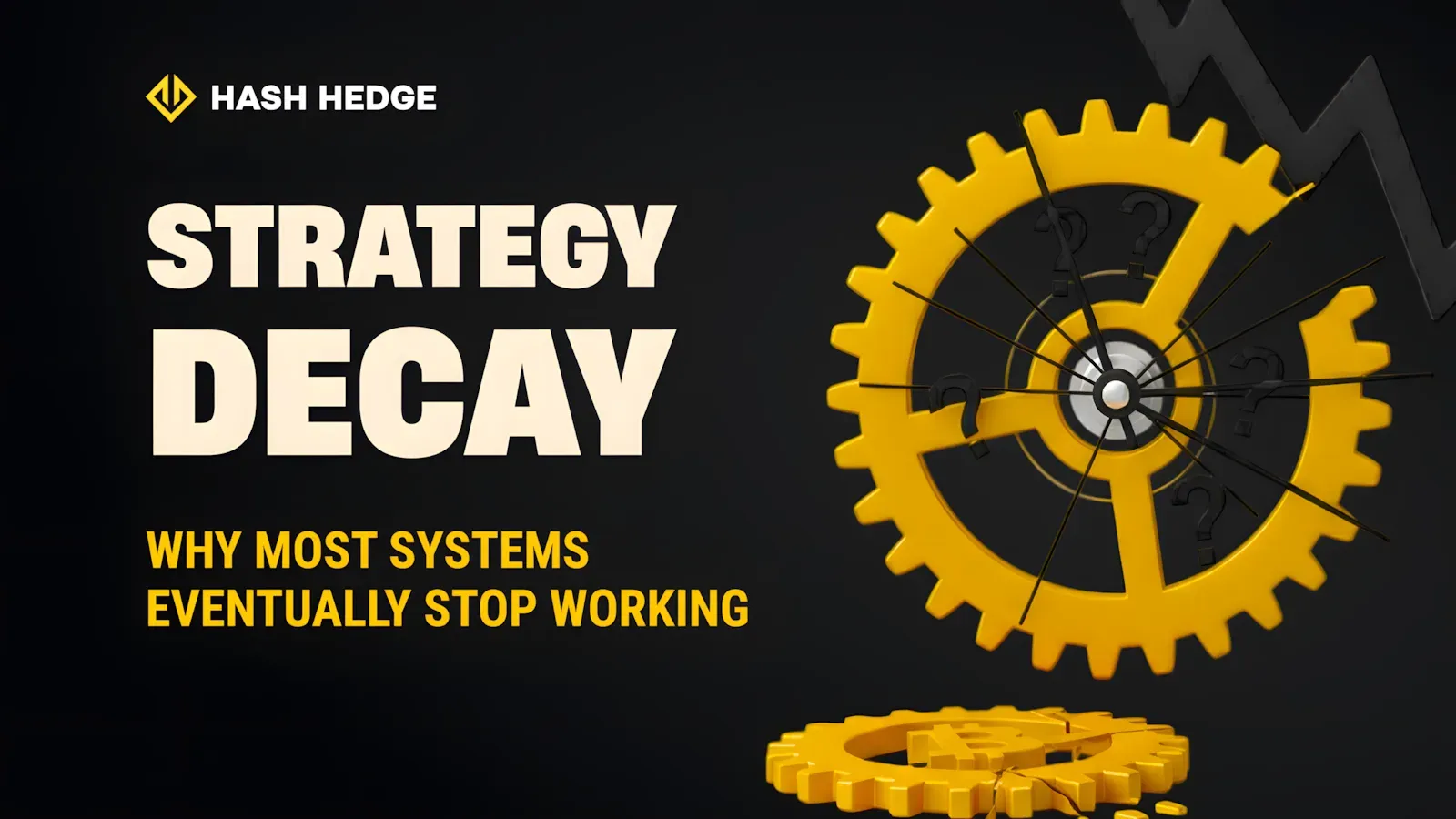
Therefore, the question of why trading strategies stop working is primarily related to changes in the market environment.
Strategy Overfitting as a Hidden Problem
When performance deteriorates, many traders try to fine-tune the system: adding filters, changing parameters, or refining entry conditions. Sometimes this produces temporary improvement, but it may lead to strategy overfitting. The approach begins to perfectly describe past price action while losing robustness under new conditions. Trading strategy testing should evaluate not the precision of individual entries, but its ability to perform across different market phases.
In some cases, the system itself remains valid, but the trader’s behavior changes. After a series of losses, there is a desire to recover faster: position size increases, entry quality declines, and trades are opened outside the plan.
As a result, trading consistency breaks down, and stability disappears. Each decision starts depending on the previous outcome rather than the rules.
This creates the impression that the strategy has stopped working, when in reality the level of trading discipline has changed.
Why Consistency Matters More Than Precision
Even strong strategies go through periods of reduced performance. No approach works equally well under all conditions: volatility, market structure, and participant behavior change. At such times, the issue is not signal accuracy, but the trader’s ability to maintain consistency.
The key factor becomes strategy robustness in trading. It depends on how well the trader can:
- Follow rules regardless of previous trade results.
- Limit risk in trading without increasing exposure after losses.
- Control position size based on current market conditions.
- Endure temporary drawdowns without changing the system emotionally.
It’s important to understand that most strategies lose effectiveness temporarily, not permanently. Changing rules during a performance decline often increases instability and distorts statistics.
Risk control in trading allows a trader to survive periods when the market does not match expectations. If capital exposure remains limited, the strategy has time to recover, and long-term results remain manageable. In this sense, robustness does not mean the absence of drawdowns, but the ability to move through them without damaging the trading process.
Adaptation Instead of Constant Searching
When a strategy stops producing results, the natural reaction is to look for a new one. However, constantly switching approaches rarely solves the problem and usually leads to a loss of trading consistency.
It is far more important to understand how to approach trading strategy adaptation. This does not mean changing rules after every losing streak, but working with the current context. During periods of increased volatility, traders need to account for larger price swings and adjust expectations. In uncertain conditions, it makes sense to reduce trading activity and avoid entries without a clear edge. When market conditions deteriorate, reducing position size becomes a logical step to maintain risk management.
At the same time, regular strategy performance analysis remains essential, focusing not on individual trades but on the stability of results over time. This approach helps preserve the core of the system while accounting for changing market conditions without disrupting the process due to short-term fluctuations.
The Role of Risk Management in Long-Term Stability
Over the long term, performance is determined not by entry accuracy, but by the quality of risk management in crypto trading. Even the strongest strategy inevitably goes through periods of reduced efficiency, and risk management determines whether a trader can preserve capital until conditions become favorable again.
If risk per trade remains stable, even a series of losing periods will not lead to critical losses. Position size management, drawdown control, and reduced exposure during periods of high volatility help keep overall risk at a controlled level.
Predictable risk also reduces psychological pressure. When potential losses are predefined, it becomes easier to follow rules and maintain consistency without trying to recover losses by increasing size or trade frequency.
In essence, consistent trading is the ability to survive unfavorable market phases without breaking the system.
Why Consistency Matters in Prop Trading
In crypto prop trading, the requirements for stability are stricter. Trading on a funded account takes place within clearly defined drawdown limits and risk restrictions.
Trader funding programs and crypto trading challenges are passed by those who can maintain consistency and adapt to the market.
When trading crypto with professional capital, the primary objective is stable performance over time.
Final Thoughts
Most strategies lose effectiveness not because they were flawed from the beginning. The reason is that the market changes while the approach remains the same. Market cycles, shifts in volatility, and changes in structure require flexibility and strong risk management.
Long-term results are built on three factors: trading strategy adaptation, trading discipline, and consistent risk control in trading. In such conditions, drawdown periods become part of the process rather than a reason to constantly change the system.
If you want to work in an environment where stability and discipline come first, Hash Hedge offers a funded account with transparent rules and the opportunity to trade with capital up to $100,000. This format helps you focus on consistency — the factor that truly determines long-term results.