Basic Order Types
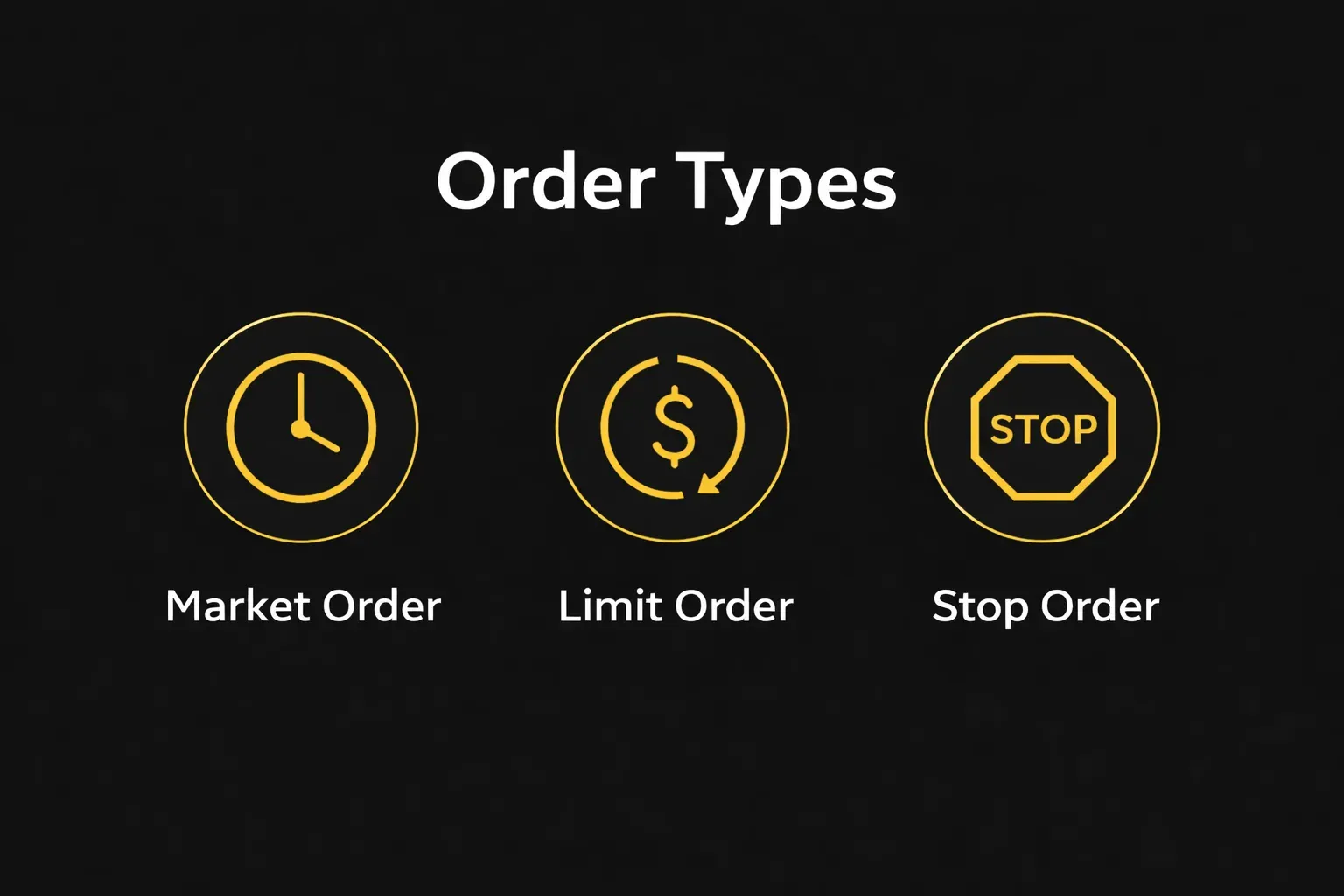
On any crypto exchange, traders work with several core execution tools. These include the market order, limit order, and stop order. These instruments are used to open and close positions as well as for risk management.
A market order is used when a trader needs to enter the market immediately. Such an order is executed at the current market price using the available liquidity in the order book.
Knowing how to work with a market order is particularly important during high volatility. In fast-moving market conditions, order execution on crypto exchanges may occur across multiple price levels, which can sometimes cause the final execution price to differ from the expected one.
A limit order works differently. It allows a trader to specify in advance the price at which they are willing to buy or sell an asset. The trade will only be executed if the market reaches that price level.
Stop Orders and Risk Management
The next category is the stop order. This tool is used to automatically open or close a position once a specific price level is reached.
The most common variation is the stop-loss order, which limits potential losses. When the price reaches the predefined level, the system automatically closes the position.
Another important instrument is the take-profit order. It is used to lock in profits when the price reaches a predetermined level.
Such orders for risk management allow traders to automate managing trade exit and help them follow the principles of risk management in crypto trading. The use of protective orders is considered one of the core principles of managing risk in trading.
Order Execution and Position Management
Trade quality largely depends on how order execution in trading takes place. On crypto exchanges, trades are executed by matching orders in the order book.
When a trader places a market order, the system immediately matches it with available orders on the opposite side of the book. In the case of limit orders, the order enters the order book and waits for execution.
Understanding how a stop order works is also important for controlling a trade. Once a certain level is reached, such an order converts into either a market or limit order depending on the configuration.
Different order types help traders organize managing trade entry and managing trade exit without constant manual monitoring.
Advanced Orders
In addition to basic tools, many exchanges offer advanced order types in trading that allow traders to manage positions more flexibly.
These include conditional orders, which are activated only when specific market conditions are met. They are often used to automate trading strategies.
Orders for taking profit and combined orders that allow traders to set multiple exit levels at once are also widely used.
Such automated orders in trading allow traders to define trade management scenarios in advance. This is especially important when working with cryptocurrency trading orders, where the market can move quickly and require an immediate reaction.
Orders and Trading Strategy
Types of orders in trading are directly connected to how a trader manages positions and plans the structure of a trade. For example, position sizing must consider not only the expected price movement but also possible slippage, market depth, and asset liquidity. Choosing the wrong order type may lead to an entry price that differs from the planned one, especially in volatile market conditions.
For this reason, when building a strategy traders determine in advance which cryptocurrency trading orders will be used to enter, manage, and close positions. For example, limit orders help control the entry price more precisely, while protective stop orders automatically limit potential losses.
Within intraday trading strategies, traders often combine several types of orders. Market orders are used to enter quickly during strong price movements, while limit orders allow traders to place predefined levels for opening positions.
In addition, the proper use of orders is part of managing risk in trading. Traders determine in advance the levels at which a position will be closed if the market moves against them and set the corresponding protective orders.
Automated protective orders also help structure managing trade entry and managing trade exit. This is particularly important in the highly volatile crypto market, where prices can move quickly over large distances. When key levels are predefined, traders can focus on market analysis rather than manually managing every trade.
| Order Type | How It Works | When It Is Used | Main Advantage |
|---|---|---|---|
| Market order | The order is executed immediately at the best available price on the market. It uses the current liquidity in the order book. | Used when a trader needs to quickly open or close a position. Often applied during strong price movements. | Fast order execution on crypto exchanges |
| Limit order | The trader specifies in advance the price at which they want to buy or sell an asset. The order is executed only when the market reaches that price. | Used when it is important to precisely control the entry or exit price of a position. | Precise control over the trade price |
| Stop order | Activated when a specific price level is reached and converts into a market or limit order. | Used for automatically opening or closing a position when a key price level is broken. | Automation of managing trade entry |
| Stop-loss order | A protective order that closes a position when a predefined loss level is reached. | The main tool of risk management in crypto trading. | Limiting potential losses |
| Take-profit order | An order that automatically locks in profit when a predefined price level is reached. | Used for automated managing trade exit. | Profit locking without manual monitoring |
Orders and Professional Trading
As traders gain experience, they begin to pay more attention to execution structure and risk control. In this process, types of orders in trading become part of a systematic approach to trading.
Over time, many traders move toward working with larger capital through crypto prop trading. In this model, traders can operate not only with their own funds but also with company capital.
Modern crypto prop firms give traders the opportunity to pass an evaluation, obtain a funded trading account, and scale their strategies without increasing personal risk.
For many market participants, trading crypto with company capital becomes the next step after a period of independent trading.
Final Thoughts
Types of orders in trading form the foundation of trade management. Understanding how the market order, limit order, and stop order work allows traders to control entry and exit points more precisely.
Using protective orders helps traders maintain risk management in crypto trading and reduces the impact of emotions on trading decisions.
In the long run, trading results are determined not only by strategy but also by disciplined trade execution.
If your goal is trading with up to $100,000 in capital, one possible path is prop trading for crypto traders. If you want to test your strategy in real conditions and gain access to capital, you can pass the Hash Hedge trading challenge and start trading crypto with company capital.