What scalping is and how it works
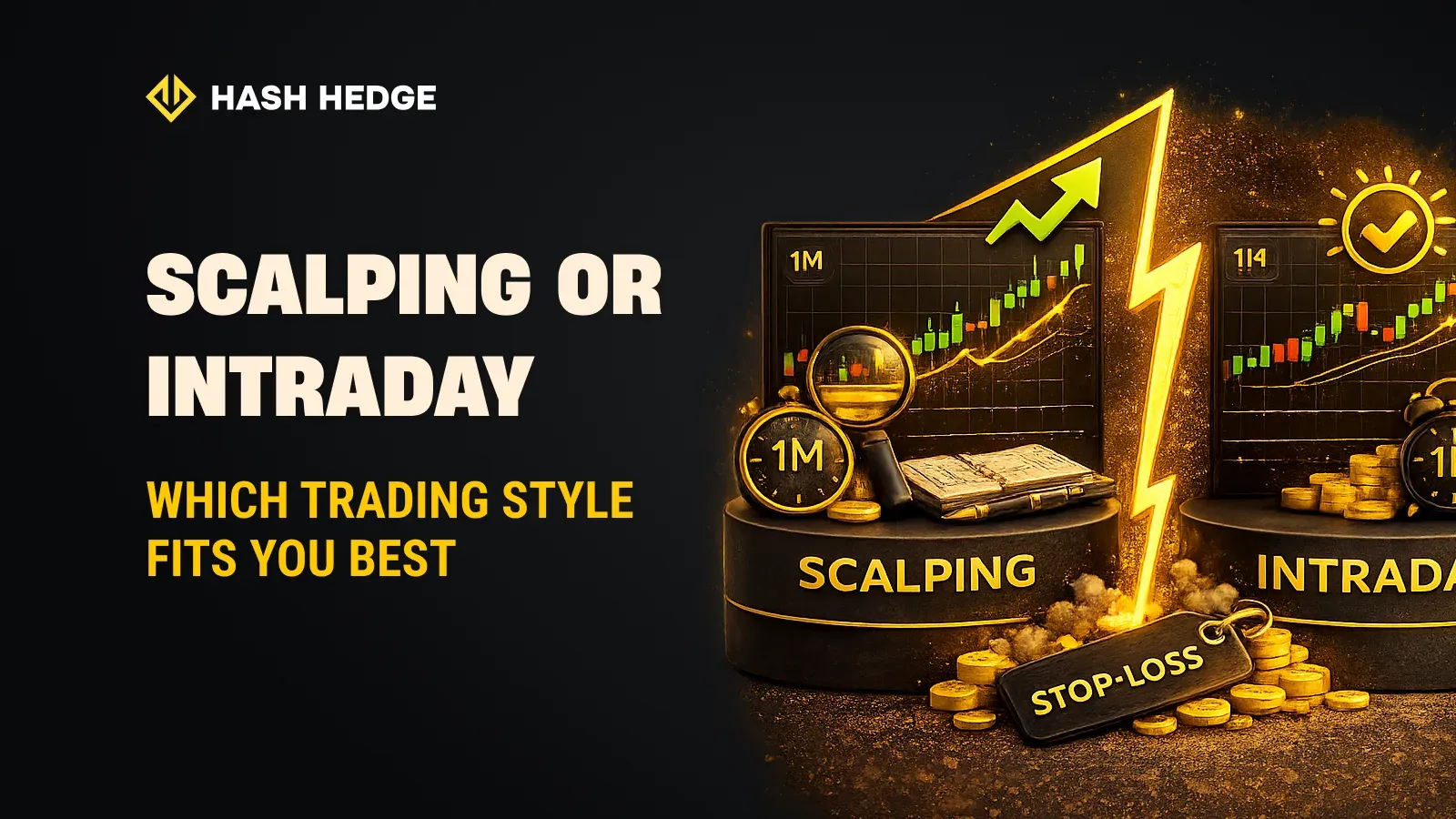
Scalping is trading very short intraday moves. Positions are opened and closed within minutes, sometimes seconds. The goal is to take a small move, repeat it many times, and build results through volume.
In crypto scalping, this often means working inside a narrow range, on market microstructure, with a high frequency of trades. A scalper needs to see order flow, reactions to levels, and instant changes in liquidity.
The main features of scalping are:
- High decision-making speed.
- Minimal time in position.
- Strong dependence on spread, fees, and slippage.
Scalping requires full concentration. There is no time for hesitation or rebuilding scenarios.
What intraday trading is and how it differs
Intraday trading involves opening and closing positions within the same trading day, but with a broader horizon. Positions can be held from several minutes to several hours.
An intraday trader works with:
- Market structure.
- The day’s context.
- Key levels.
- Impulses and pullbacks.
Unlike scalping, it is not only the entry point that matters here, but also understanding where the market is within the day: at the start of an impulse, in continuation, or in exhaustion.
Why these styles are often confused
What is the difference between scalping and intraday trading? The line between them is often blurred. A trader may trade M1–M5 and consider themselves an intraday trader, while in practice trading like a scalper. Or hold positions for hours and call it scalping.
The difference is not the timeframe, but the logic. Scalping is about micro-moves and immediate market reaction. Intraday trading is about intraday structure and scenarios.
For scalping, lower timeframes are key: M1, M3, M5. What matters here is:
- Reaction to levels.
- Speed of price returning.
- Volume behavior at the moment.
For intraday trading, the base is more often M15, M30, H1, with mandatory reference to higher timeframes. The intraday trader looks at where the market is in the overall structure and searches for entries within that context.
That is why intraday trading requires more analysis, while scalping requires more reaction.
Scalping vs Intraday Trading
| Criteria | Scalping | Intraday Trading |
|---|---|---|
| Trade horizon | Seconds to a few minutes | From several minutes to several hours |
| Number of trades per day | High, frequent | Limited, selective |
| Main focus | Micro-moves, price reaction | Intraday structure, scenarios |
| Timeframes | M1, M3, M5 | M15, M30, H1 + higher |
| Entry type | Fast, reaction-based | Planned, structure-based |
| Work with levels | Local levels, micro-zones | Key daily levels, ranges |
| Role of volume | Instant reaction, spikes | Scenario confirmation |
| Time in position | Minimal | Moderate |
| Psychological load | High, constant pressure | Medium, more waiting |
| Concentration requirements | Very high | High, but with pauses |
| Sensitivity to fees and spread | Critical | Moderate |
| Typical mistakes | Overtrading, impulsiveness | Overholding, hesitation |
| Best suited for those who… | Think and react quickly | Prefer analysis and planning |
| Risk of a single mistake | Low, but accumulates | Higher, each trade carries more weight |
| Compatibility with crypto prop trading | Requires strict discipline | Easier to control within rules |
How risk management works in each style
In scalping, risk is spread across a large number of trades. A single mistake is rarely critical, but a series of mistakes quickly eats the result. That is why discipline, strict loss cutting, and tight control over the number of entries come first. A scalper operates in a constant decision flow, and any loss of control shows up in the balance almost immediately.
In intraday trading, the logic is different. Each trade carries more weight, and one mistake can cost a noticeable part of the daily limit. That is why intraday traders more often work with predefined scenarios, fixed risk levels, and a limited number of trades per day. There are fewer trades, but more responsibility for each, and risk management becomes part of the trading plan.
Psychology: where pressure is higher
Scalping creates constant tension. High decision frequency, the need to react quickly, and the lack of pauses between trades are draining over time. This style suits those who feel comfortable under pressure, make decisions quickly, and do not get stuck in doubt. The ability to act without hesitation is critical here.
Intraday trading puts pressure in a different way. There is more waiting, more uncertainty, and more time spent running scenarios in your head. A trader has to hold pauses, observe how the situation develops, and make decisions with incomplete clarity. It suits those who are comfortable waiting, can hold positions, and do not panic on pullbacks. The pressure is not sharp, but stretched out, and that becomes the main psychological challenge.
Where beginners most often make mistakes
Beginners often choose scalping because it looks simple: enter, take a move, exit. In reality, they most often run into:
- Information overload and trying to account for too many factors at once.
- A series of fast stop-outs that break rhythm and confidence.
- Emotional burnout from constant tension and high decision speed.
In intraday trading, mistakes usually look different. Beginners:
- Enter trades without a clear plan or scenario.
- Hold losing positions hoping the market will turn.
- Confuse a correction with a reversal and lose context.
Both error models are tied not so much to the style itself as to a mismatch between expectations and reality, and a lack of experience with market dynamics.
How to understand which style fits you
There is no universal answer here. Choosing a trading style is always tied to personal traits: decision-making speed, attitude to risk, ability to tolerate waiting, and overall stress resilience.
Some feel comfortable acting fast and staying engaged constantly. Others need time to analyze and think through scenarios. Some handle a series of losing trades calmly, others lose confidence after just a few. The same goes for waiting: for some, hours at the chart pass unnoticed; for others, it becomes a serious psychological strain.
Observing how you react to the market in real conditions almost always gives a more accurate answer than any generic advice. The goal is not to force yourself into a format, but to choose one you can sustain long-term.
Why style choice matters especially in crypto prop trading
In crypto prop trading, the trading style directly affects rule compliance. A scalper can quickly hit daily limits due to the number of trades. An intraday trader can get stuck in one position and miss the day.
Traders working through a prop firm for crypto traders and trading with company capital have to choose a style that allows risk control, not just staying in the market.
There is no room for romance here. Only alignment between trading format, rules, and personal psychology.
Final Thoughts
Scalping and intraday trading are not competitors, but different tools solving different tasks. One is built on speed, reaction, and micro-moves; the other on structure, scenarios, and the ability to wait. The real mistake is trying to trade in a format that does not match your habits, rhythm, and psychology. The market exposes these mismatches quickly.
The more honestly a trader assesses their strengths and weaknesses, the less temptation there is to copy someone else’s style, and the higher the chance of building a sustainable trading model. What works is not “what everyone does,” but what you can hold over time.
If you want to understand which style fits you and test it in conditions where risk is limited by rules, it makes sense to look at crypto prop trading — for example, by starting to trade with Hash Hedge and using company capital.