Why Traders Choose Scalping
Scalping in crypto is a direct response to how the digital asset market is fundamentally structured. Crypto trades continuously, without a centralized venue or a unified liquidity pool, which means price discovery happens simultaneously across dozens of exchanges. This fragmentation creates natural inefficiencies and micro-gaps that rarely exist in traditional markets. For a trader attuned to these distortions, scalping becomes less about “taking small profits” and more about leveraging the market’s structural imperfection at its most granular level.
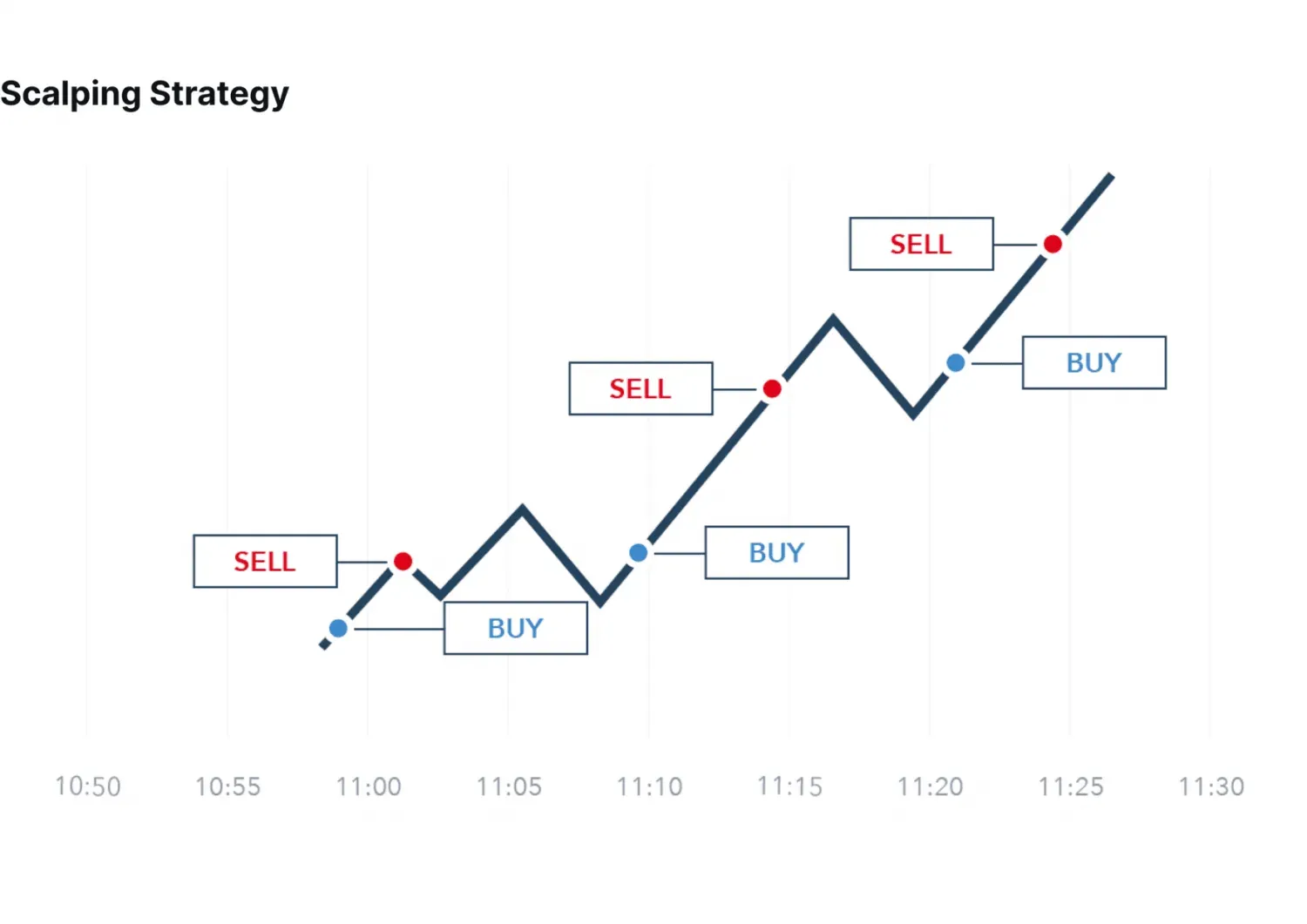
What makes scalping particularly relevant in crypto is the speed at which information is absorbed by the market. News, liquidations, algorithmic reactions, and sudden liquidity injections all propagate faster here than in equities or Forex. The result is an environment where micro-moves form and vanish before they become visible on a candlestick. Scalpers operate in that liminal space — between the first shift in order book pressure and the moment the broader market acknowledges it.
How It Works
To understand why scalping works, you need to look beyond charts and into the mechanics of the order book. Every price movement begins with a simple imbalance between buyers and sellers, but in crypto, this imbalance is amplified by the diversity of participants. Across the board, you’ll find algorithms, high-frequency bots, retail traders and market makers.
These actors influence the market. Scalpers thrive at the intersection of these flows, reading not candles but intent: sudden shifts in resting liquidity, thinning spreads and the subtle signaling that precedes a burst of volatility.
The Psychology of High-Speed Trading
Scalping demands a mindset that is fundamentally different from swing or positional trading. It’s built on constant dialogue with the market’s micro-behavior. A scalper is forced to operate in the present tense. This creates a form of mental clarity rare in long-horizon trading: decisions are stripped down to pure reaction, free of bias and expectation. Yet this same clarity makes scalping psychologically intense. There’s no room for hesitation, and every moment of distraction carries a cost.
A trader must internalize not only technical signals but also the subtle cadence of volatility. When liquidity dries up, when spreads widen, when liquidations accelerate — the trader must feel it as much as see it. Scalping is a discipline of micro-timing, where emotional neutrality becomes as essential as technical precision.
How Important Is Speed in Scalping?
Speed is more than a competitive advantage. The fastest players — whether humans or algorithms read the market at a different level of resolution. They see liquidity shifts before they develop into momentum, and they act on signals that most traders never notice. Speed allows a scalper to enter the market while risk is minimal and exit before volatility becomes dangerous. But speed is also a barrier: the faster the market becomes, the more the gap widens between those who can process micro-structure and those who rely solely on chart patterns.

This reliance on speed creates a hierarchy of the market. Traders with better execution, lower latency, and deeper experience navigate micro-moves with precision, while others arrive seconds too late and mistake leftovers for signals. Yet speed alone doesn’t define a successful scalper. What matters is the ability to interpret speed — to understand why the market is moving quickly or slowly at a given moment.
And if you already know how to read that speed — it’s time to trade with capital that actually rewards it. Join Hash Hedge and unlock up to $100,000 in real funding.
Your strategy, our capital, zero personal risk.
Best Strategies for Scalping
Don’t look at charts first. Look at liquidity. You need to know:
- Where does real size sit?
- Who is providing liquidity at each level?
- Is the depth stable, or does it disappear the moment price approaches it?
- Are there hidden orders sitting behind thin walls?
- How quickly is liquidity replenishing after each sweep?
These questions matter because liquidity shapes behavior more directly than candles ever will. A market with slow replenishment tells you that any decent-sized market order can create a short-lived run. A market full of spoofed liquidity tells you someone is actively shaping behavior. A market where the bid is absorbing unusually well often signals a local bottom forming long before price reflects it.
When Not to Scalp
The best scalpers aren’t the ones who trade the most. They’re the ones who know when the market doesn’t deserve their attention. Crypto has long stretches where spreads widen unpredictably, liquidity becomes ghost-like, and price action starts reflecting algos cycling through routine sequences. During these phases, even great setups degrade quickly.
Good scalpers avoid:
- Low-volume weekends.
- Post-news drift.
- Dead hours around funding.
- Mid-range environments.
- Situations where depth looks staged rather than genuine.
If the market isn’t producing clean micro-moves, scalping becomes more like flipping coins with slightly better timing. A solid trader learns to step back, wait, and preserve mental and financial capital for the moments that actually reward skill.
The Bottom Line
Scalping in crypto isn’t the style most people imagine when they think of “fast profit.” It’s closer to craftsmanship: a mix of repetition, pattern recognition, and emotional steadiness under pressure.
The real takeaway is simple: scalping rewards consistency more than brilliance. If you show up with a clear process, respect risk more than your ego, the strategy starts to make sense. So scalping isn’t for everyone.